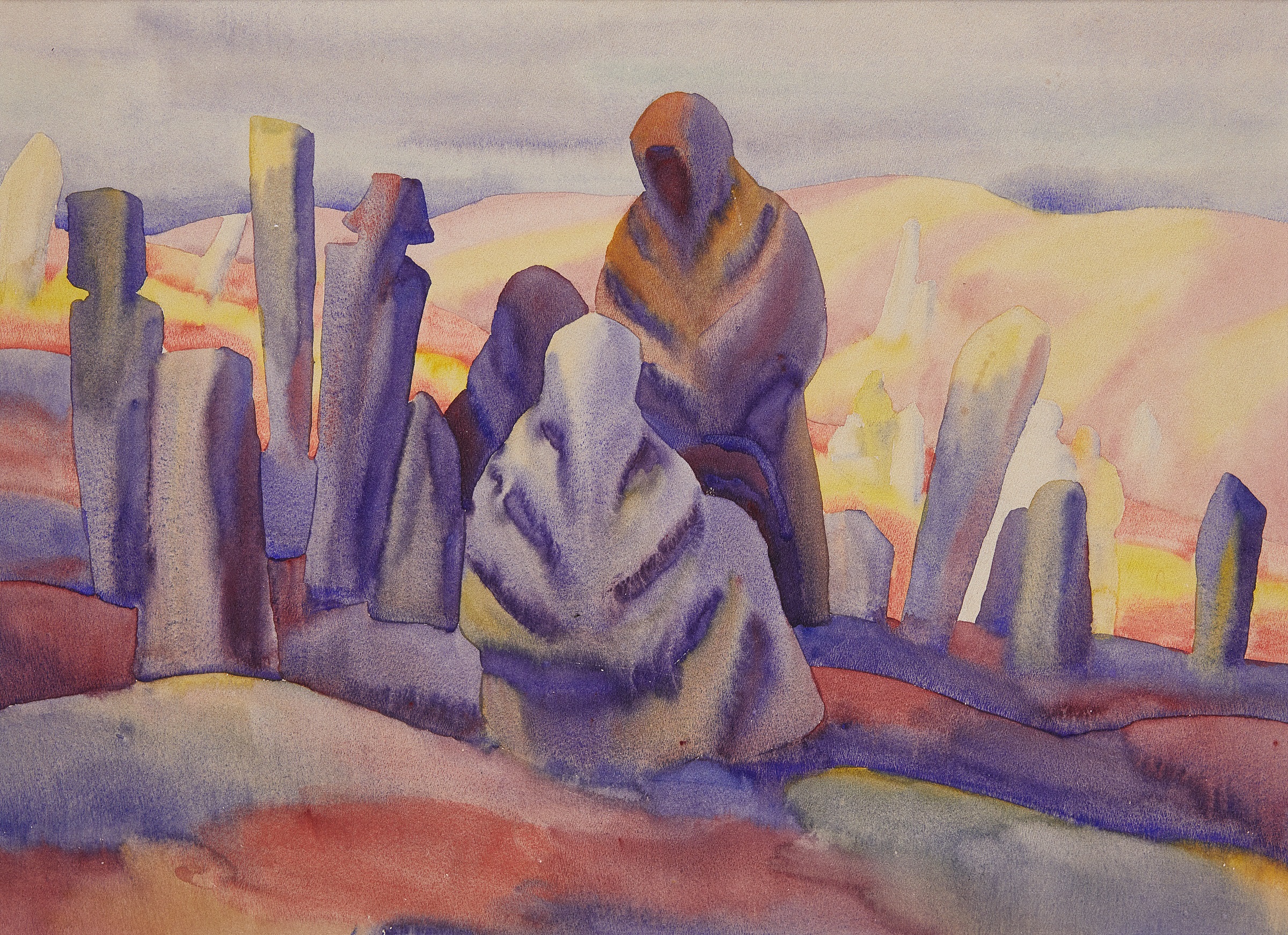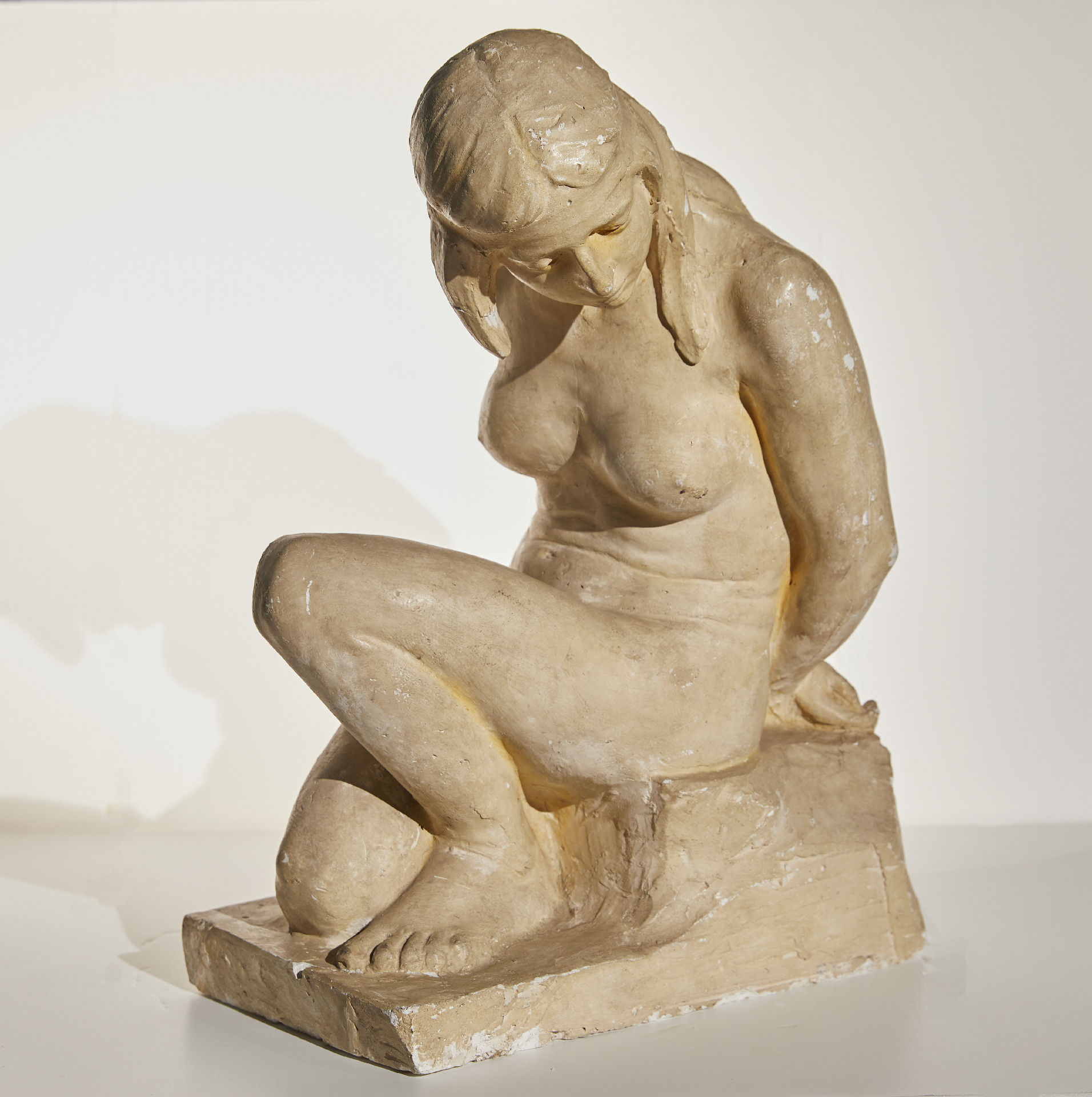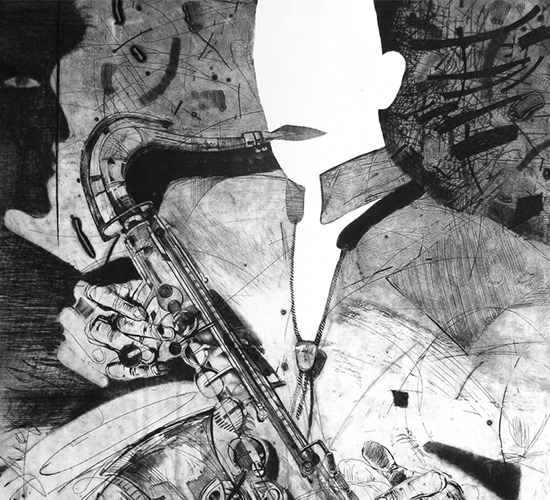

 Ivan Milev Muglizh Monastery, 1925 Bencho Obreshkov Violetta, 1939  Dimitar Kazakov Rite, 1978 Petar Dochev Chemical Plant Devnya Lika Yanko Gods, Antennae, Men, 1969
|
 |
The Department of Painting
by Maria Vassileva Collecting the pictures, part of which are now in the Paintings Department of the Sofia Municipal Art Gallery, started as early as 1929. Kosta Vulev, the first curator of the Sofia Museum set up by an order of the then Mayor of the capital, General Vladimir Vazov, laid the foundations of the collection. He also drew up the statute of the Museum, which provided “for the creation of a picture gallery with a department for (a) works by artists of Sofia, treating primarily subjects of the capital city itself; and (b) a gallery of portraits of deserving Sofia residents.” (Central State Archive, f. 1k, list 2, a. e. 1258). During the period 1929-31, some 165 museum objects were brought together: pictures, photos, archaeological and ethnographic items. The early collecting activity can be traced thanks to the diary kept by Kosta Vulev (Diary of the Early History of the Sofia Museum, published by Elinka Boyadjieva, col. Serdica -Sredets -Sofia, 1997, v. 3). Thus, for instance, he notes that he has seen the director of the National Archaeological Museum, Professor Gavril Katsarov, who “expressed his willingness to cede to the Municipal Museum, as soon as it should acquire premises of its own, many of the pictures about Sofia or by Sofia artists, for which there is no place in the rooms of the State Museum” (Feb. 16, 1929). And further on: “In the district town hall I found the following pictures, which should be taken into account: 1. An artistically executed coloured picture of “Sofia Market” by the artist A. Mitov in the office of the mayor. In the same office is also the afore-mentioned picture “Old Sofia” depicting the site of the present-day Market Hall. 2. A picture sized 20 x 80 cm: “In memory of the consecration of the Saint Alexander Nevski Memorial Cathedral”… I asked the mayor of the second district municipality to see to it that these be kept in store for the museum.” (Feb. 27, 1929). “I visited the steward of the municipality. I asked him to be shown the portraits left uncared-for away in the attic. They brought me seven of them, of which I took a note. In addition, they brought me a plaster bust of the late Queen Eleonora.” (Feb. 29, 1929). In a “Report by the keeper of the library and museum to the chief of the administrative department of Sofia Municipality (CSA, f. 1 k. list 2, a. e. 1261) of September 4, 1929 Kosta Vulev writes; “During his visit to the Jubilee exhibition, His Majesty the King deigned to authorize the use of the royal collection by the municipal museum, instructing me to approach in that matter the Director of the Royal Scientific Institutes, Dr Ivan Bouresh.” And Vulev goes on to say: “Particularly on the issue that interested me most - what pictures and other materials concerning Sofia were there to be found in the royal collection, he told me that amid the pictures made by Oberbauer to order of His Majesty the ex-King Ferdinand there were none on the subject of Sofia and that such could be found in the departments of the palace itself. He directed me to refer the matter in a letter to Her Royal Highness the Princess who, as mistress in the palace, can authorize the viewing of the royal pictures and libraries that are to be found in the palace itself.” It is clear, as can be seen from the records of those early days, that the collection was taking shape as an assemblage of works by artists of Sofia or primarily such as were devoted to the history and present of the city. In the course of time, this orientation of the gallery has always been maintained to a greater or lesser degree. Although the gallery did considerably expand its interests in later days, a great number of works are kept in its stores, reflecting diverse aspects of the capital city.
Scanty is the information concerning the inauguration of the Sofia City Library and Museum in the municipal building on Banski Square on December 1941 (Serdica magazine, 1941, issue 8). The Mayor of Sofia, Engineer Ivan Ivanov, announced in a speech the opening of the “city library, the city picture collection and the city archive”, adding: “Our collection of pictures is not large. I think that one of the reasons why the city has not been more generous in spending its means for the acquisition of pictures is the fact that there was no suitable place for them to be displayed and adequately protected.”
The Gallery was to evolve as an independent institution at a much later date, when part of its holdings were set aside in view of the establishment of the future National Art Gallery. The latter was created by a decree of the Ministerial Council of the People’s Republic of Bulgaria on November 24, 1948. For the formation of the new gallery were used the collections of the Archaeological Museum, the City Museum, the Ministry of Public Education, the Ministry of Finance, etc. The Arts Council under the chairmanship of Dr Lyuben Stoyanov and having as members: Vassil Mihailov, Professor Stefan Ivanov, Professor Dechko Ouzounov, Iliya Beshkov, Professor Ivan Lazarov, Alexander Stamenov, Tsanko Lavrenov, Peter Slavov, Ivan Kereziev, Vassil Zidarov, and Dimiter Dimitrov, keeper of the Municipal Gallery, was assigned the task of “selecting, by virtue of the mandate given to it, from the museums and collections works belonging to all movements from the National Revival Period to the present-day.” (Archive of the Sofia Municipal Art Gallery, file “Incoming and outgoing letter for the City Committee” from the years 1950, 1951, 1952 and 1965, p. 24). In a minutes of October 20, 1950 that has been preserved, are listed 79 works (66 paintings and 13 sculptures), which were transferred from the City Museum to the National Art Gallery. These include 7 works by N. Pavlovich, 7 by S. Dospevski, 5 by I. Mrkvi?ka, 3 by D. Dechev, 3 by T. Todorov, 2 by N. Tanev, 2 by M. Georgieva, 2 by K. Todorov, one each by A. Mihov, A. Mitov, I. Anghelov, B. Denev, S. Ivanov, S. Venev, B. Angeloushev, V. Rilski, A. Nikolov, V. Emanouilova, B. Kotsev, V. Kavaldjiev, H. Stanchev, D. Ouzounov, D. Gyudjenov, B. Schatz, and others (CSA, f. 538, op. 1, a. e. 1). Some of the most renowned canvases of the Municipal Gallery adorn to this day the exhibition halls of the National Art Gallery: Portrait of Krustyo Sarafov in the role of Falstaff by D. Ouzounov, In the Field by H. Stanchev, A Worker’s Family by N. Balkanski, Portrait of Dora Gabe by S. Ivanov and others. The first display of the National Gallery was opened on March 27, 1949 in the building of the former Sofia Casino at 1 Gourko Street, restored in 1944-5. Following “the systematic work done on taking over the collections” (CSA, f. 538, op. 1, a. e. 1), the National Art Gallery, now considerably enriched, was opened anew on August 8, 1959. When the National Gallery was moved to the former Royal Palace in 1954, the hall at 1 Gourko St. was handed over to the Union of Bulgarian Artists. The Sofia Municipal Art Gallery, established as an independent institution in 1952, moved into this building in 1973 and has been occupying it to the present day.
It is not easy to establish any principles according to which the collection of the Sofia Municipal Art Gallery has been built up in the course of time. Quite frequently it was the personality of the director or the specific circumstances of the moment that have determined acquisitions.
Ordinances of the Sofia City People’s Council are preserved (the earliest is from 1950), which show that each consecutive year commissions were appointed for the purchase of “museum objects and items for the Sofia city museum” or the acquisition of “pictures, sculptures and other items.” The composition of these bodies varied from 5 to 14 members, the binding rule being that there should always be a representative of the Gallery, the department of Culture at the Sofia City Council, the Union of Bulgarian Artists (for years on end this was Dechko Ouzounov); however, such institutions as the Academy of Art, the National Art Gallery, the Bulgarian Academy of Sciences, the Ministry of Culture, the Museum of the History of Sofia and even the Museum of Military History could also be represented. Sometimes commissions were appointed for the purchase of works from specific exhibitions or even of an individual work; a case in point was the acquisition of a Portrait of Stalin by Tseno Todorov in 1954. In a letter of 1962, the Union of Bulgarian Artists designated three artists as members of the Arts Council to the Gallery, a body which functioned independently of the commission for the purchase of works.
A number of further interesting facts could be cited. Thus, in the archives of the Sofia Municipal Art Gallery is preserved a letter from the Committee for Science, Art and Culture of August 27, 1951 to the Gallery, in which an idea of the Gallery’s management for the staging of an exhibition is rejected. In another letter of March 16, 1951, the same Committee is instructing the Gallery precisely which pictures should be purchased from an exhibition dedicated to Georgi Dimitrov. In a letter to the Committee for Science, Art and Culture of June 11, 1952 ( in the Gallery archive), the curator of the Museum, Dimiter Makedonski, and the chief of the Education and Culture department at the Sofia City People’s Council, S. Ignatievski, request that a representative be appointed to serve on the commission for the purchase of paintings and sculptures for the City Museum at the Sofia People’s Council of the Deputies of the Working People.” These random facts throw a certain light on the mechanism governing the acquisition of works of art during that period. Neither did the fact that the Gallery’s manager was appointed only in the capacity of keeper contribute to the Gallery’s independent development. It was not until 1966 that the curator Atanas Zhekov started acting as director, a post which, theoretically at least, conferred greater powers. The practice of voluntary, or allegedly voluntary, transfers of collections or parts of collections from one institution to another is undoubtedly the reason that today it is so difficult to trace the authentic origin of a given work, to find out who first bought it and from whom. On the backs of certain canvases the seals can be seen of all consecutive institutions that have owned them, while the respective file cards register only the last source. Investigation is also rendered impossible by the fact that the old records of transfers and inventory books have been poorly kept or are altogether missing for certain periods. A telling case in point is the following: In “Information on the state of the Sofia Municipal Art Gallery and some problems facing the Gallery” of March 26, 1968 (Archive of the Gallery), the director, Atanas Zhekov, writes: “What I have inherited from the previous keeper was at a frozen point as far as the documentation was concerned. Even the most rudimentary list of the works housed in the Gallery was lacking. Nearly a year and a half since his dismissal it has been impossible to ascertain the inventory numbers of quite a few works - some of them in the stores, others dispersed in various departments of the City Council.”
The only discernible priority in the acquisition policy of the Gallery was the purchasing of works devoted to the city of Sofia, and that primarily from competition exhibitions. Records have survived from 1964, when the first annual competition for works on the theme of “Sofia” was held in connection with the twentieth anniversary of the Ninth of September. In 1968, a statute of this competition was published, in which one reads that the prize offered is to be “awarded every year for works of art treating the “Sofia” theme or recreating the life of the youth of Sofia.” Separate prizes were provided for the various art forms. In the domain of the visual arts, the following prizes were offered: six for painting (3 each for “composition” and for “landscape and portrait”), and three each for graphic art and sculpture. In 1965, some 80 artists took part in the competition with 127 works. The selection committee, which decided on the distribution of prizes, also advanced a proposal that more than 20 works be purchased and added to the holdings of the Gallery. A brief statistical survey shows that one work was purchased from the “Exhibition of Sofia Artists” in 1975, one from the National Art Exhibition “Sofia 1982”, three from the National Art Exhibition “Sofia 1984”, twenty-four from “Sofia 1987”, three from “Sofia 1988”, and eighty-seven from “Sofia 1989.” The greatest number of accessions came from one-man shows (jubilee, retrospective, and posthumous exhibitions) - more than 120 items. The purchases from heirs and private owners were another form of acquisition. A smaller number have been bought from group exhibitions, while the Gallery has as a rule purchased from 1 to 5 works from almost all National Exhibitions held during the period 1975-91. An exception was the “Small Format” National Art Exhibition 1989 in Sliven, from which 23 paintings were purchased with funds of the Committee of Culture and handed over to the Gallery. The last acquisitions from a National Exhibition date from 1991. Since then the Gallery has had practically no budget for the purchase of works, and all recent additions are due to donations on the part of artists and their families or the leasing of rooms for exhibition purposes. It may be of interest to note that among the earliest dated paintings owned by the Gallery are such works as Portrait of Nikolai Stankovich (1870) by Ivan Dimitrov, Portrait of Elenka Avramova (1872) by Nikolai Pavlovich, and Portrait of Pencho Zlatin (1873) by Christo Tsokev.
As far as the different genres of painting are concerned, it should be noted that the Gallery possesses a remarkable collection of land- and townscapes from Sofia and its environs, and of portraits of prominent public and cultural figures of the capital city. Some of the notable works in this domain are: the “Sofia Markets” by Mitov and Mrkvi?ka, the views of streets and buildings by Dimiter Gyudjenov, Nikola Petrov, Nikola Tanev, Tsanko Lavrenov (his unique Bombing of Sofia), Peter Mladenov, Tsenko Boyadjiev, Alexander Stamenov, Boris Ivanov, Preslav Kurshovski, Danail Dechev, Zlatyu Boyadjiev, Petko Abadjiev, Konstantin Tringov, Yordan Geshev, Atanas Mihov, Ekaterina Savova-Nenova, Georgi Pavlov, Alexander Petrov, Konstantin Shturkelov, Zina Yurdanova, Slavka Deneva, Vladimir Manski, Vladimir Kavaldjiev, Zdravko Alexandrov, Zoya Paprikova, and from more recent times: the urban scenes by Naiden Petkov, Todor Hadjinikolov, Peter Dochev, Roumen Gasharov, Svetlin Roussev, Magda Abazova, Stefan Yanev, Iliya Milkov, Mihail Kamberov, Andrei Daniel, Ivailo Mirchev, Mariana Marinova, and others. Among the portrayals of politicians, public figures and intellectuals particularly worthy of note are the portraits of Alexander Stamboliyski by Tseno Todorov, of Georgi Mihailov, the first mayor of Sofia, by an unknown artist, of Petko Karavelov by Nikola Ganoushev, the portraits of Christina Morfova and the actress Marta Popova by Ivan Mrkvi?ka, of Teodor Trayanov and Yordan Yovkov by Tseno Todorov, of Anton Mitov by Boris Mitov, of Boyan Penev by Dimiter P. Daskalov, of Marko Markov by Ivan Boyadjiev, of Academician Mihail Arnaoudov by Iliya Petrov, of Svetoslav Minkov by Kiril Tsonev, of Vassil Barakov by Vladimir Rilski, the three portraits of Vaska Emanouilova by Karl Yordanov, Donka Konstantiova and Svetlin Roussev, of Rafael Mihailov by Peter Petrov, of Boris Ivanov by Alexander Stamenov, of Dora Gabé by Sultana Sourouzhon, of Boris Angeloushev by Milka Peikova, of Peter Mladenov by Georgi Kovachev, of Metodi Andonov by Maria Stolarova, of Dechko Ouzounov by Dimiter Kirov, of Atanas Yaratov by Emil Stoichev, of the pianist Lazarov by Ivan B. Ivanov, of Georgi Chapkunov by Emil Stoichev, of Vera Nedkova by Kalina Tasseva, of Valeri Petrov by Andrei Daniel, of Vihroni Popnedelev by Gredi Assa, etc. Fifteen portraits of Georgi Dimitrov by various artists should not be overlooked. Especial mention must be made of the outstanding collection of self-portraits: of Nikola Arushev, Christo Berberov, Vladimir Dimitrov-The Master, Goshka Datsov, Nikolai Evrov, Zina Yurdanova, Preslav Kurshovski, Elissaveta Konsoulova-Vazova, Anton Mitov, Ivan Mrkvi?ka, Georgi Mashev, Assen Nikolov, Vera Nedkova, Iliya Petrov, Stoyan Sotirov, Vassil Stoilov, Nenko Balkanski (with the artist Vassil Ivanov), and others.
On the whole it may be said that since the collection has grown in a rather chaotic manner and regardless of any established principles, certain periods and artists are very well represented, while others show considerable gaps. It must be added, however, that the collection, which numbers some 3,000 items, contains works of exceptional value both for the Gallery and for the history of Bulgarian art in general. There are also others, less brilliant in quality, which nevertheless help us to obtain a richer and more comprehensive picture of Bulgarian painting. Let us now examine in greater detail the holdings of the Paintings Department at the Sofia Municipal Art Gallery and try to set forth its specific character by highlighting the more notable works.
Of the artists, who were active in the years preceding and following the Liberation from Ottoman bondage, the Gallery possesses five portraits by Nikolai Pavlovich. It was precisely portraiture, which was developing most intensively during this period and which was in a sense the link to the painting of the National Revival period. Like most of his contemporaries, Pavlovich had received his training abroad and was under the influence of the academic manner. He tried, however, to integrate the Bulgarian tradition, the achievements of the best icon-painters, with the classical heritage. The result was an interesting fusion, which outlined the future evolution not only of the portrait genre, but of Bulgarian painting in general. In the female portraits owned by the Gallery - The Landlady of N. Pavlovich, Female Portrait (1880), Portrait of Elenka Avramova (1872), Teofana - Betrothed, one can discern, despite the adherence to a strict compositional pattern (half-figure against a uniform dark background) a change in the very conception of the image, but also in the painterly handling. The flatter and largely monochrome treatment of The Landlady with its cold and formal atmosphere evolved into a complex tonal elaboration of the face and clothing and an air of worldliness, especially marked in Teofana - Betrothed. A similar evolution can be traced in the two male portraits by Christo Tsokev. In Portrait of Pencho Zlatin, the sitter wears a national costume, and the composition is rather rigid. In Male Portrait already emerges a new approach, much more imaginative and painterly. Georgi Danchov was the artist most firmly bound to the old tradition. While in Portrait of Hadji Kolyo one can even detect some errors of drawing, Portrait of a Child is a nearly flawless academic work in the classical vein.
Worthy of interest is the Gallery’s collection of works by the earliest post-Liberation artists: Ivan Mrkvi?ka, Anton Mitov, Jaroslav Vešin, and Ivan Anghelov. They bear testimony to the changes in Bulgarian painting that were setting in during this period: intensive development of the genre with meticulous attention to subject-matter, description and detail. The individual human being was no longer at the centre of the artist’s quests. These were directed towards the depiction of the real world with all its variety and tangible concreteness. Both in literature and the visual arts, the ethnographic study and description of the people’s mores and way of life were considered a sign of fidelity to the national cause suited to keep up the spirits of the people. The pictures of Anton Mitov At the Fountain (1899) and Market in Sofia (1899) are classical examples in this respect. They are interesting not only because of their folkloric and ethnographic character. They are actually genre scenes situated in the open countryside. The landscape plays nearly as important a part as the human figures. These canvases belong to the earliest attempts at plein air painting. The artist is fascinated by the effects of sunlight, the transparency of the air, the play of shadows cast by the trees. While the figures are depicted with meticulous accuracy, the landscape setting is distinguished by a certain ethereal quality, sketchiness of treatment and luminosity. The same is true of Ivan Mrkvi?ka’s Going to Market, one of his classical genre paintings, in which the artist’s attention is focused on the subject-matter and the costume of the central character, but no less on the winter landscape, which envelops the scene and occupies the greater part of the canvas. A peculiar lyrical atmosphere distinguishes Ivan Anghelov’s Harvest and Rose-picker. Though these works were meant to represent genre scenes, they are actually poetical impressions, the impact of which rests on the pictorial harmony between figures and landscape.
Besides genre painting, portraiture continued to evolve as a favoured art form. Both Mrkvi?ka and Mitov have painted portraits; Mitov’s Self-portrait is a widely known work. Mrkvi?ka’s output in this genre is extremely varied: formal portraits (Exarch Yossif), “salon” portraits (The Actress Maria Popova and Portrait of a Lady), romantic portraits (Head of a Girl). His mastery can be seen in the skilful construction of the form, the rich and, indeed, expressive working out of the backgrounds and draperies, as well as in the innovative approach - the placing of the sitter in a natural setting. The details of a Japanese print reproduced in Portrait of a Lady suggest that the impact of contemporary developments in European painting had reached, however remotely, Bulgarian artists too. Ivan Dimitrov was one of the most distinguished portraitists in the first decades after the Liberation. A pupil of his father, Dimiter Kunchev, a well-known icon-painter of the Tryavna School, and trained later at the art academies in Bucharest and Paris, he combined in a highly distinctive manner national traditions and academic knowledge in his work. Being one of the first portrait painters of the post-Liberation period, he was employed as artist at the court and produced hundreds of portraits of members of the royal household, of former chairmen of the National Assembly, ministers and public figures. His Bagpipe Player (1888) is of particular interest. It is symptomatic of a time when, alongside the dominant descriptive realism in Bulgarian painting with its naturalistic tendencies, the first attempts at handling more complex aesthetic and painterly tasks were becoming noticeable. Bagpipe Player combines the features of a genre scene and a portrait. The attempt to place the figure in a natural setting betrays the artist’s striving to break with the established compositional patterns and to indulge in freer painterly handling. The work is typical of the transition from religious to secular painting, from local to European artistic traditions. The Sofia Municipal Art Gallery owns several other portraits by Ivan Dimitrov, of which Lyutskanov and especially Female Portrait are true classics in the genre.
The earliest serious attempts to break away from the old academic line in painting date from the early twentieth century. The founding of the Savremenno Izkoustvo (Contemporary Art) Society in 1903-4 was an expression precisely of these trends characterized by the interest not only in subject-matter but also in plastic values and by the desire to apply certain of the lessons of West-European painting. Nikola Mihailov, Tseno Todorov, Stefan Ivanov, Nikola Petrov, Elena Karamihailova rank among the notable artists of this period.
The first two decades of the century saw the emergence of new genres in painting, with landscape and the psychological portrait taking the lead. The nude, the single-figure composition and still life were likewise in the ascendant. The works of Georgi Mitov and Yakim Banchev, both trained at the Art Academy in Turin, count among the noteworthy possessions of the Sofia Gallery in the genre of the nude. The nudes of Yakim Banchev, painted in the period 1902-8, are on the borderline between the academic figure and the classical treatment. In Female Nude of 1908, the artist shows greater freedom of pictorial approach both in the compositional build-up and in the paint handling. In another “Female Nude” one catches an echo of the romantic leanings of the epoch in the dramatically red curtain enveloping the body and the crown on the woman’s head. The still earlier works by Georgi Mitov, Study of a Nude (1894) and especially Half-naked Italian Woman with a Copper Tray (1897), reveal the extraordinary pictorial talent of a little known artist. Although he remains within the classical tradition, he has a good command of lighting, which imparts a peculiar appeal to his works. Half-naked Italian Woman surprises with the impasted brushstrokes, a device rarely met with at that time and giving a modern ring to the painting.
Most of the younger Bulgarian landscape painters were pupils of Jaroslav Vešin and developed further his achievements. The Sofia Municipal Art Gallery possesses two interesting works by Vešin, in which the landscape is accorded a considerable place. These are a Harvest in watercolour and another picture of the same title in oils. Both are designated by the author as sketches. But whereas the canvas is a finished work in a rather strict academic style, the watercolour evidences a much freer approach to nature. The landscape predominates over the genre scene, while the harvesting process itself and the haystacks offer the artist an opportunity to unfold his painting skills, relieving him from any stiffness and thus heralding the future development of the landscape. It is precisely from Vešin’s time onwards that landscape evolved into an independent genre of painting, no longer serving as a mere background. Combined with a portrait or a figure composition, it really becomes an emotionally (and aesthetically) integrated component of the picture. The most significant development during this period was the definite breaking away from academism and the increasingly strong and fruitful influence of Impressionism, which affected most Bulgarian artists to a higher or lesser degree. The Gallery possesses works by all distinguished exponents of this new movement on Bulgarian soil: Nikola Petrov, Yordan Kyuvliev, Nikola Tanev, Assen Belkovski, Konstantin Shturkelov, Alexander Moutafov, Atanas Mihov, Christo Berberov, Marin Georgiev-Oustagenov, Vladimir Dimitrov-Chiraka, Peter Morozov.
The work of Nikola Petrov is generally regarded as the most innovative for that period. His name is associated with the rejuvenation of Bulgarian painting at the beginning of the century and the progressive tendencies, which raised it to a new level in its development. He was the originator of the modern urban landscape and was closest to the problems of Impressionism, which, though refracted in a peculiar manner, have contributed significantly to the radical shift in the understanding of the nature of painting. The Sofia Municipal Art Gallery owns nine landscapes in watercolour and oils by Nikola Petrov. The National Theatre of 1912 is a real masterpiece. It represents a blend of the classical and the Impressionist manners: the solid composition is softened by the golden luminous colour scheme, the firmly structured form is rendered less rigorous by the tiny brushstrokes that build it up, thus creating the impression of masses dissolving in space. The work is not only of high artistic quality, but is also indicative of the complex development, which Bulgarian painting was undergoing in the first decades of the century.
The portrayals of Bulgarian intellectuals marked a new development in the portrait genre. Tseno Todorov took a consistent interest in it. In the Gallery’s collection there is a Portrait of Teodor Trayanov by him, painted in 1909, a work of intense emotional commitment and a certain romantic air, which raise it above the level of a merely academic canvas. Likewise transcending the academic conventions is Portrait of Nadezhda Ivanova by Stefan Ivanov, marked by the concrete, yet somewhat conventionalized character of the representation, while his Portrait of a Lady of 1942, though evoking a certain “drawing room” atmosphere, reveals the mastery of a consummate painter. In the Shadow is a work, which shows Stefan Ivanov as an innovator in Bulgarian art, opening a new field of researches in painting: the flickering lights and shadows cast on the face and dress of the sitter. A similar line was taken up and raised to an even higher level by Elissaveta Konsoulova-Vazova. She and Elena Karamihailova have created a gallery of intimate and psychologically penetrating portraits. Having both received their academic training abroad, these two women artists had not only a rich artistic career, but also exerted a considerable impact on the development of painting during the first half of the century. Their works evidence the mixed influences of German Romanticism and German Impressionism. In Front of the Mirror (c. 1912) by Elena Karamihailova shows the application of certain advanced for that period principles. The introduction of a mirror and the working out of the double image is a device, which enables the artist to indulge in the play of reflections, the intriguing gradations of coloured highlights and the delicate shading of hues. Neither is the appearance of children’s portraits accidental. The child’s image is used in the work of the two artists as a symbol of purity and poetry. While building up the shapes, the brushstrokes are fused into a harmonious unity with the dominant tonality. The contours disappear behind the impasted dabs of paint. The colours are imbued with light imparting an ethereal quality to the works without their losing their material aspect. The Sofia Municipal Gallery possesses several outstanding works by Elissaveta Konsoulova-Vazova. Besides the artist’s self-portrait, two canvases should be mentioned here: In Front of the Fence (1926) and On the Porch. They are painted in a very bright colour scheme, in large brushstrokes, particularly legible in the background. In brightening the colours to the utmost, the artist achieves an effect of the outlines dissolving in space and of a vivid radiance emanating from the picture. Actually in both works the background is a piece of countryside, but its handling is broader and more allusive so that the effect is rather of something abstractly decorative. This type of outdoor portraits has almost no counterpart in the art of the 1920s and marks a new milestone in the evolution of Bulgarian painting. The period of academic portraiture had definitely come to a close, new sub-genres of the portrait were coming to the fore, the artists were concerned not only with capturing the likeness of the sitter, but also with the building up of a complete, harmonious composition in keeping with the contemporary trends in European art.
Due mention must be made here of another group of artists, who were associated with the influences of Symbolism and the decorative aesthetic of Art Nouveau (the Sezession) of the early twentieth century. In the collection of the Gallery one can discover the whole range of motifs and themes typical of these movements: religious, folkloric and ritualistic, the themes of death, love and the woman, etc., as well as a rich variety of pictorial modes, ranging from the utterly illusionist to the absolutely conventional, from the concrete to the abstractly decorative. Here are to be found such emblematic works as Yana’s Nine Brothers, Krali Marko, Self-portrait, Melancholy by Georgi Mashev, Composition, Despair, Forces, Crucifixion, Muglish Monastery, Cinderella by Ivan Milev, Wood Nymphs’ Ring Dance by Nikola Mihailov, Monastery by Ivan Penkov, as well as a number of landscapes, portraits and still-lifes by Sirak Skitnik. Ivan Milev’s Crucifixion (1923) is of special interest, since it reflects a curious tendency in Bulgarian art of that period. This work is distinguished by the intertwining of several stylistic trends: expressivity of the image, symbolic character of the composition, decorativeness of the background in the vein of Art Nouveau. This blending of styles is also to be seen in the work of Sirak Skitnik and Vladimir Dimitrov-The Master. The early works of the latter have been described at times as in the decorative Sezession manner, at times as expressive. The truth is that neither of these styles has been employed by the Bulgarian artists of that period in its pure form. It is precisely the singular fusion of stylistic trends that makes their paintings unique.
The 1930s and the early 1940s witnessed the appearance of a number of talented painters, whose work was radically different from what had been achieved before them. They were united in the Society of New Artists, which for a long time was synonymous with innovation, experimenting and successful manifestations in the country and abroad. Their main contribution to Bulgarian art was the preoccupation with the plastic problems of the picture in keeping with the latest tendencies on the European art scene. The artists that we associate with these quests (not all were members of the Society of New Artists, but most of them shared its interests) and of whom the Gallery possesses works, are: Eliezer Alcheh, Alexander Zhendov, Ekaterina Savova-Nenova (9 canvases, of which the magnificent Portrait of Gerda Angelousheva), David Perets, Boris Elisseyev, Bencho Obreshkov (24 compositions including such masterpieces as Mademoiselle Violette of Nice of 1939; Male Portrait, Still-life with Fish, Composition - Goldfish, Still-life with Palette), Kiril Tsonev, Boris Ivanov, Pencho Georgiev, Stoyan Venev, Vladimir Dimitrov-The Master, Nenko Balkanski, Vera Loukova (her wonderful portraits My Sister and Woman with White Kerchief), Vera Nedkova, Stoyan Sotirov, Peter Mladenov, Donka Konstantinova (with the interesting Portrait of Vaska Emanouilova), and others.
Still-life (1939) by David Perets is symptomatic of the processes going on in Bulgarian art during this period. The composition is disposed before an open window so that the still-life motif is enriched, as it were, by the landscape behind it. This overlapping of genres was characteristic of all European art in the thirties. In Bulgaria similar compositions were painted by Bencho Obreshkov, Boris Ivanov, Nenko Balkanski, Ivan Nenov, Kiril Tsonev, Boris Elisseyev, Sirak Skitnik, and others. A fruit bowl with fruit and a clay vase with a bouquet of flowers are in the centre of the canvas, placed on a draped cloth freely falling from the wicker table, the impression of informality being enhanced by the fruits and mushrooms scattered around. A wonderful landscape with a lake, trees and hills opens to the right. Two painterly conceptions vie for dominance in the build-up of the picture: the curtain is treated in the ‘classical’ manner, with lights and shadows and gradations of bright and dark. The fruit, flowers and landscape are rendered in the “modern” way, with coloured shadows and without the use of black. In combining these two principles, Still-life by David Perets embodies, as it were, the tendencies in Bulgarian art during that period - towards breaking away from the “conservative” manner and exploiting the discoveries of the Post-Impressionists.
Balcony with Viaduct (1936) by Ivan Nenov is one of the masterpieces in the collection of the Sofia Gallery. It was probably done after a pencil sketch brought back from Italy, as the artist was in the habit of doing (there is a smaller version in the Art Gallery of Sliven). The composition is clearly constructed in terms of the interplay of space and light. Here is again to be seen a favourite motif with the artists of the 1930s: the open window. It enables the painter to grade the planes in space and to seek interesting counterpoints of light and shadow, of dark and bright. Ivan Nenov is fascinated by the reflections of objects, the bizarre encounters and intersections of shapes, which are as real as they appear fantastic. Though the subject of the picture is quite ordinary, it is not devoid of a certain metaphysical note. The rigorously analytical construction of setting and objects does not deprive the artist of his poetical feeling. It is this delicate balance between mysterious stillness and subtle spirituality which makes Ivan Nenov’s style unique. And Balcony with Viaduct is one of his most distinctive creations.
One more strand in the development of Bulgarian art in the thirties and late forties should be mentioned here, existing alongside the quests of the “New Artists”: the line of the fashionable, “drawing-room” painting. Among its exponents, works by whom can be seen in the Gallery, are: Ivan Tabakov with his Portrait of a Lady, Iliya Petrov with Diana (1946) and Portrait of a Lady - Albena, Vassil Stoilov with Roumyana (1936), Rouska Marinova with Female Portrait, Boris Mitov with Portrait of a Lady (1932), Rouzha Rakilova with Portrait of a Lady (1934), Georgi Popov with Portrait (1942), Tsvetana Gateva with Dancer, and others.
The period of the late forties and the fifties was one of the bleakest in the history of contemporary Bulgarian art. One painting seems to exemplify it best and that is Drills in Campina by Vassil Barakov. Barakov was one of the first Bulgarian artists to paint industrial landscapes. After 1944, his interests in this respect were stimulated by the official policy of encouraging the creation of works of art devoted to the themes of human labour and the life of workers. He and Zlatyu Boyadjiev made many studies at the construction of the Pernik-Volouyak railway line. He visited also the big industrial works in Pernik, Kremikovtsi, Pirdop, Zlatitsa, and Roudozem. In 1947, a group of Bulgarian artists were commissioned to recreate the life of miners working at the big mines in Romania. Among these, besides Barakov, were Eliezer Alcheh, Bencho Obreshkov, Zdravko Alexandrov, Vladimir Kavaldjiev, Zlatyu Boyadjiev, and others. The pictures they brought back with them or painted shortly thereafter were shown in a big exhibition. The response of the critics was scathing and the exhibition was prematurely closed. The painters were reproached that the pessimistic pictures brought from Romania did not evoke the cheerful, life-asserting spirit of socialist renovation and construction. Branded as formalists, many talented Bulgarian artists had to give up painting for a prolonged period of time and to take up commercial art or even to emigrate. Vassil Barakov’s Drills in Campina dates from those years (1948). In his “Notes on some pictures, persons and experiences”, Barakov recounts that he had made numerous studies for his canvas. In its ultimate form the composition looks nearly perfect - both rich in detail and stripped of all that is superfluous. If one compares it to the early industrial landscapes by the artist, the difference leaps to the eye - the harshness of the volumes is softened, the line has become less abrupt. The artist is concerned primarily with the psychological characterization of the object, with rendering the emotional state, which it conjures. The heavy, massive terrain in the foreground is counteracted by the vertical forms of the drilling equipment, rising into the skies and extending backwards to infinity. The middle ground of the picture, where the workers’ houses are seen, is as if squeezed between the leaden blue sky and the cheerless brownish-black earth. What makes the impact of the picture so intensely dramatic is the feeling that in this almost non-terrestrial landscape there seems to be no place for man. Drills in Campina is not only a striking work of art, it is the symbol of an epoch.
The early 1960s were a period of turbulent change; they witnessed the emergence of a new, strong generation, which was to shape the fortunes of painting for decades to come. The Exhibition of Young Artists in 1962 was the first serious manifestation of this new wave of artists, but its also stirred up a heated controversy on the meaning of art. The early works of Svetlin Roussev, Ivan Kirkov, Yoan Leviev, Dimiter Kirov, Encho Pironkov, Dimiter Arnoudov, Georgi Bozhilov, Genko Genkov, Georgi Bayev and others mark a significant page in the history of Bulgarian art. Unfortunately this period is only scantily represented in the collection of the Sofia Municipal Art Gallery. The following works may be cited as characteristic of it: Barges (1962) by Svetlin Roussev, Sozopol (1962) by Georgi Bayev, Portrait of Meyerhold (1967) by Yoan Leviev, Blue House (1066) by Dimiter Arnaoudov, The Crypt (1966) by Dimiter Kirov, Jazz by Georgi Bozhilov. To these should be added the collection of landscapes by Kiril Petrov from Komshtitsa, Vitosha Mountain, the Vladaya Gorge and the Kremikovtsi Mine (bequeathed to the Gallery by Vaska Emanouilova) of the late 1950s and early 1960s, which thanks to their almost abstract character are not only likely to change our notion of this artist, but add new touches to the overall picture of Bulgarian art of that period. Worthy of note are also certain works by Alexander Petrov-Lavandulata such as Samarkand (1960) and Landscape (1967), whose intense colours remind us of the artist’s sovereign role in determining the coloristic make-up of the picture. Let us also add the industrial landscapes by Maria Stolarova and Peter Dochev, marking a new stage in the development of the genre. The Gallery possesses a considerable number of works by Magda Abazova (15 paintings), Vessa Vassileva (19), Dimiter Kazakov (10), Naiden Petkov (16), Georgi Bayev (16), Roumen Gasharov (11), Encho Pironkov (13).
The seventies and eighties saw the emergence of a variety of interesting new currents. The collection of the City Gallery offers a rich diversity of works from this period. Characteristic is the trend towards simplification of the image, the turning back to stable forms and carefully thought out compositions as a natural reaction against the “painterly” modes of the 1960s. The accurately modelled objects and shapes offer a different view of reality, refracted through the distance of their “photographic objectiveness”. The turning towards the convincing authenticity of the objective world brought again to the fore the form as the organic carrier of ideological content and plastic qualities. In the early seventies, this problem was addressed in various ways by Toma Trifonovski, Mihalis Garudis, Atanas Yaranov, Stefan Rodev, and others.
Symptomatic of the period under review is Dimiter Bouyuklyiski’s composition Holiday of 1975. The forms, simplified to the utmost, are subordinated to the oval line, which makes for visual tranquillity; the undulating line of the clothes and hair lends variety to the surface without producing tension. The figures fill up the entire canvas, and the movement seems to continue beyond its borders. The colours are of the signal type: red and yellow, black and white. They are triumphantly bright, provokingly applied in large local patches. The image affects emotionally the senses through the combination of shapes, lines and colours.
The contribution towards the building up of a national style was another significant feature of the art of the 1970s. In some paintings principles are at work, which were drawn from the art of Bulgarian icon-painting. In others predominate themes of rural life, motifs of feasts and rituals. It is not by chance that in the early seventies the issue of continuity in the national aesthetic was brought up. The quest for a decorative, naively grotesque style became the preoccupation of many artists. Some painters showed a profound sense for the national, interpreting it in its pure form, as can be seen in paintings by Samouil Seferov, Radi Nedelchev, Nadezhda Kouteva, Keazim Issinov, Dimiter Kazakov, Spas Neshovski and the early works of Georgi Trifonov and Dimiter Bouyuklyiski. Still others, like Dariya Vassilyanska, Tekla Alexieva and Christo Simeonov, adopted the principles of naïve art in their effort to achieve an atmosphere of festiveness and exaltation.
Ivan Dimov’s painting A Visit to the Museum (1973) is a characteristic example of the changes that were setting in in Bulgarian art in the early seventies. It presents in an emphatic way the image of a new generation, which was assuming a different attitude towards the surrounding reality and its interpretation, changing both the range of themes and the methods of their treatment. To the direct, emotional response of the artists of the sixties it opposed philosophical reflection, an indirect, more sophisticated approach to historical and ethical issues. Alongside the primitivist-folkloric trend (both in subject-matter and plastic interpretation) and the “Neue Sachlichkeit”, there emerged hyper-realism (photo-realism). Notwithstanding the differences in the means of expression, these three tendencies seem to stem from a common impulse: the desire to evoke a world that is more laconic, more rational and in a sense richer in substance and meaning.
A Visit to the Museum is the first work, which we associate with photo-realism and which affected strongly the development of this style in Bulgarian art. Painted for the National Art Exhibition of 1973, the picture retains in a certain sense the traditional framework of an easel painting and at the same time introduces new elements. The photo collage finds its justification in the theme itself. The artist’s attitude toward the subject - a reference to the not so distant historical past - is filtered through the cold objectivity of photo-realism. Emotion has given way to the rational analysis of characters and historical facts. Colour plays a subordinate role, being entirely dominated by a speculative attitude toward the surrounding world. Teofan Sokerov, Elena Sokerova, Mihail Sazdov, Tekla Alexieva and some other artists were working at that time in the style of photo-realism.
Special mention must be made here of the sizeable collection of paintings donated to the Gallery by Nikolai Maistorov, which give a fairly comprehensive idea of this artist’s work.
The early 1980s were a period in which the changes in the visual arts were to precede the dramatic events marking the end of the decade. The breaking up of the established system began in the mid-eighties, but it was prepared by developments in the preceding years. Many of the most interesting painters of the new generation were to take an active part in the processes directed against the cramping system of administration of the arts and the restrictions imposed on the freedom of artistic expression. The names of Milko Bozhkov, Sasho Stoitsev, Svilen Blazhev, Andrei Daniel, Vihroni Popnedelev, Gredi Assa, Bozhidar Boyadjiev, Nedko Solakov are associated with the first nonconformist initiatives and attempts at gaining greater creative freedom in the arts. This period witnessed the appearance of a number of promising young talents and the emergence of new currents. Milko Bozhkov, Maria Zafirkova, Stanislav Pamoukchiev, Valentin Kolev, Zahari Kamenov showed a penchant for monochrome imagery. Edmond Demirdjian, Kiril Christov, Selim Gigov, Yuriy Vassilev produced works in the vein of a specific Bulgarian constructivism. Nikola Karadjov, Volodya Kenarev, Violeta Radkova were adherents of the Neue Sachlichkeit (new objectivity) movement. Andrei Daniel, Nedko Solakov, Vihroni Popnedelev pursued a line in painting, in which the “text” and irony played an essential role, while Sasho Stoitsev, Vasko Ivanov, Stefan Yanev were committed to hyperrealism. All these currents and modes of expression reveal but a small part of the complex picture of the decade.
Among the most interesting works of the 1980s owned by the Gallery, which imparted diverse nuances to the new quests, the following ought to be mentioned: Correlation, The B. Voinov Programme - A Series, Time by Sasho Stoitsev; The Other Day, After Work, Snack Bar, Office Bus by Vihroni Popnedelev; Theatrical October by Andrei Daniel; In Memory of Zhendov by Dimiter Voinov; Composition by Bozhidar Boyadjiev; Eternity by Nedko Solakov.
Especially worthy of note is Milko Bozhkov’s The Window Opposite, shown for the first time in 1982 at the Sixth National Exhibition of Young Artists in the rooms of the 6 Shipka St Gallery. It is typical not only of the artist’s researches in the late 1970s and early 1980s, but also of certain new trends emerging in this period and pursued also by other painters of this generation (Sasho Stoitsev, Vihroni Popnedelev, Georgi Trifonov, Andrei Daniel, Dimiter Voinov). In those years, Milko Bozhkov created a series of pictures (Sound of Bells over the Earth, Apocalyptic Vision, Dou You Hear the Ropes Creaking? [owned by the Gallery], And Night Is Looking into My Windows, Monologues, Nest, Requiem for Tarkovski, Dedicated to the Town of Roussé), which set him in sharp contrast to the dominant aesthetic of the period and rightfully assigned him the leading place in a new current in Bulgarian art. What the artist stands for in these works is the intellectual type of painting. Although most of them are devoted to familiar themes, suggested by the national art exhibitions, they do offer a different viewpoint. Desert landscapes, lonely figures and desolate spaces are presented as an alternative to the spontaneous, chromatic, expressive mode of painting born in the sixties. The artist is searching for new ways of appealing to the viewer, who was already expecting something different. The shift is towards a profounder, more penetrating interpretation of the theme in hand. The narrative unfolds on several levels, leading the spectator beyond what is immediately visible. No attempt is made to offer ready-made formulas, the canvas is left “open” to the viewer’s response. Expressive painting is subdued in favour of concentrated thought. Milko Bozhkov has a peculiar flair for the conceptual in art. It was no chance that he participated in the earliest unconventional manifestations in Bulgarian art in 1985-6.
By the early eighties, a number of young artists as well as members of the older generation were turning to the primitive for inspiration. In their search for an artistic identity they resorted to an aesthetic which, besides offering an original plastic system, was associated with such notions as the primeval and the authentic. They were thus able to achieve a new expressiveness of the image, investing it with the magic symbolism of ancient rituals. They felt this to be necessary in order to oppose the established mental and formal patterns, to “react” against the extreme aestheticism or “elusiveness” of the image in the associative-metaphorical approach or against the studied objectivity of the preceding photo-realism. The 1980s saw the disappearance of the naïvely sentimental tendency (another variant of the primitive), which had come to the fore in the early seventies. The principal mode adopted was that of the “intellectually processed primitive” (Diana Popova).
The pictures of the Yule-Log series by Svilen Blazhev clearly exemplify this trend and at the same time usher in the transition to the subsequent developments in recent Bulgarian art (the Sofia Municipal Gallery possesses two splendid examples of 1982). They can rightfully be described as the heralds of a new wave in the late eighties, when many young artists adopted diverse versions of the primitive modes. It is then that Bulgarian art can be said to have definitely lost its stimuli. The ideological restrictions forced artists to seek refuge in already exhausted and atrophied styles of painting, sculpture and the graphic arts. Similar thoughts, feelings and experiences were being reproduced by the same plastic means. Similarity became a salient characteristic of culture, identities disappeared. One of the ways of restoring the lost equilibrium was for artists to resort to the forms, symbols and signs derived from Bulgarian rural culture and folklore and recalling the forgotten values of patriarchal society. Motifs from woven rugs appeared in painting, obsolescent wooden instruments were transformed into abstract sculptures, the osier of traditional wicker-work was used for the construction of compositions, worm-eaten window-frames were directly displayed in exhibitions - all this betrayed a frequently unconscious search for an identity of one’s own, a turning to traditional culture as a means of reinterpreting the present through the surviving fragments of the past. Of the artists that were active in this field one should mention Kolyo Karamfilov, Galina Shehirian, Vesko Velev, Roumen Zhekov, Roumen Chitov, Iliya Zhelev, Milko Pavlov, Assen Zahariev, while Lyuben Kostov and Nedko Solakov contributed individual works.
Of the generation, which appeared on the art scene in the mid-eighties, the Sofia Municipal Art Gallery possesses works by: Anghel Christov, Nousha Goyeva, Mariyana Marinova, Vesko Velev, Milko Pavlov, Stanislav Germanov, Stanimir Videv, Stefan Zarkov, Assen Zahariev, Zdravko Palazov, Elena Panayotova, Darina Tsoureva, Dinko Stoyev, Lyuben Kostov, Ralitsa Ignatova, Lyudmil Lazarov, Dimiter Lalev, Anastas Konstantinov, etc.
It is hardly possible in an introductory essay to show in all its richness the diversity of personal achievements, creative styles and even art currents and modes, represented in the collection of the Sofia Municipal Art Gallery and covering a period of one century. It is to be hoped that the present catalogue will not only confirm the existence of some of the tendencies outlined above, but will also give occasion for a re-examination and possible reassessment of the processes in Bulgarian art. We also hope that it will prove of use to the art-loving public at large, as well as to the pupils and students in the specialized art schools and higher institutions, and especially to the community of professional artists, art historians and art critics. It may well be that a closer acquaintance with the rich holdings of the Sofia Gallery will lead to new analyses, evaluations and the staging of interesting exhibitions.
|